WASHINGTON/NEW DELHI, Aug 26: The US has halted issuing new visas for truck
drivers following a fatal crash in Florida involving an Indian driver. Three
people—American citizens—were killed in the accident.
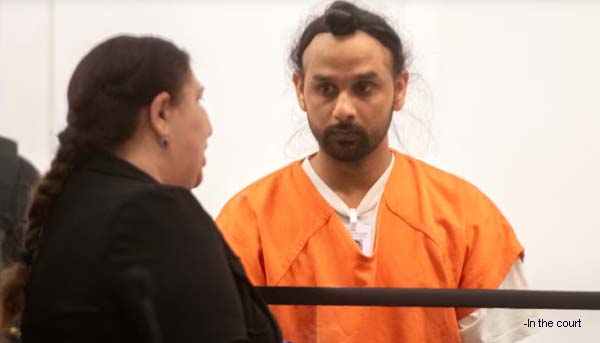
Harjinder Singh (28), the driver who was at the wheel, has been accused of
making a prohibited U-turn which led to the collision on August 12. He has been charged with homicide, traffic rule violation and illegal immigration. He also failed an
English test. The authorities allege Harjinder had entered the US illegally
from Mexico in 2018.
Harjinder, who escaped to California after the accident, was caught and brought
back to Florida. Produced in the court, he was denied bail bond on Saturday.
He is being held in the St. Lucie County Jail.
He made the illegal turn on the highway about 80 km north of West Palm Beach,
according to the Florida Highway Patrol. A minivan in the next lane rammed the
truck’s trailer, killing the minivan’s driver and two passengers. Harjinder
and a passenger in his truck escaped without injuries.
The crash led to a fight between US Department of Homeland Security and California
Democratic Gov. Gavin Newsom over how Harjinder, allegedly an illegal immigrant,
obtained a work permit and driver’s licence in the State.
US Secretary of State Marco Rubio said, “The increasing number of foreign drivers
operating large tractor-trailer trucks on US roads is endangering American lives
and undercutting the livelihoods of American truckers”. And the ban on new visas
for foreign truck drivers was imposed.
How did Harjinder get the licence: In 2018 Harjinder entered the US
illegally via Mexico and settled in California. In 2021 he was granted work
authorisation under the Biden administration after applying for asylum. In 2023
he received a CDL from California, which met Federal REAL ID requirements. Later
travelled to Florida. denied bail bond, West Palm Beach, Marco Rubio, settled
in
In a nutshell, Harjinder's work permit was federally approved, allowing him
to legally work and obtain a CDL. The California DMV confirmed that it followed
Federal verification protocols when issuing his licence.
Following the crash, Harjinder flew back to California, but was later arrested
and extradited to Florida to face charges.
The case has sparked a debate on how States handle licensing for illegal immigrants
with pending asylum claims.
Punjabi drivers in the crosshairs: The fallout of the ban is likely
to affect the Indian diaspora. Although not directly affected by the ban, it
has raised concerns among an estimated 150,000 Punjabi truck drivers working
across the US about what next. Many hail from the Sikh community, which has
become the backbone of the long-haul freight industry. With the visa ban, thousands
of aspiring drivers have also lost hope. At the same time, the drivers already
working fear heightened scrutiny and potential deportation on flimsy grounds.
Explainer on drivers ban: The US Government's ban on visa for drivers
is a pause on the issuance of new worker visas for foreign commercial truck
drivers—not a cancellation of existing visas held by current foreign drivers
working in the US.
What’s paused: New visa applications for foreign truck drivers under
categories like: H-2B (temporary non-agricultural workers); E-2 (investor visas);
and, EB-3 (skilled workers, including truckers)
Who are not affected: The ban has not affected existing visa holders.
Those already in the US with valid truck driver visas are not being deported
or having their visas revoked. Drivers with B-1 visas (used by Mexican and Canadian
truckers for short-term entry) are also unaffected.
The number of truck drivers entering on these visas is relatively small—around
1,500 to 1,400 per year under H-2B. That is, the visa pause affects only a small
number of people aspiring to come.
Currently foreign drivers make up about 18% (637,200) of the US trucking workforce
of 3.54 million as of 2025.
However, the accident is leading to heightened scrutiny of foreign drivers
and licensing standards.
Global ripple effects: The visa freeze may impact several other countries
too that supply drivers to the US like Mexico, Ukraine and the Philippines.
Meanwhile, Canada, which has a large number of Punjabi drivers, may experience
rush of applicants with the US market blocked. As for the US, any review of
existing drivers could likely disrupt supply chains and raise costs for consumers.
To speak of political ramifications, the case is deepening partisan divides.
California’s Democratic administration defended its licensing procedures. Critics
argue the ban risks undermining economic resilience while advocacy groups are
calling for better vetting and training rather than exclusion.
Industry experts warn that the decision could exacerbate existing labour shortages
in the US trucking sector.
Whatever, the uncertainties looming over thousands of Punjabi and other drivers
and their families cannot be wished away.







 )
)