SANTA CLARA (California), Nov 23: In one of the most turbulent episodes in
modern corporate history, Jensen Huang was reinstated as chief executive officer
of Nvidia on Monday, just 11 days after resigning over a series
of extramarital affairs that sparked a $1.5 trillion market rout
and a national security probe.
The board’s reversal followed an extraordinary weekend of direct lobbying from
President Donald Trump, assurances from senior US intelligence officials, and
an impending shareholder revolt that threatened to destabilize the broader U.S.
stock market.
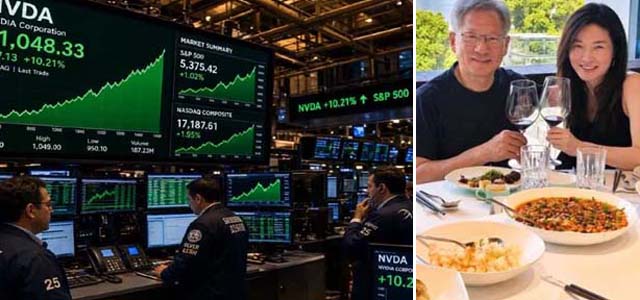
Following Monday’s announcement, Nvidia shares surged more than 31%, clawing
back nearly $1 trillion in market value in a single trading session.
While the board initially insisted it had no plans to bring him back after
revelations of workplace affairs—including one with an executive suspected of
spying for China—a combination of financial panic and White House intervention
forced a dramatic U-turn.
Just days before the reinstatement, Nvidia board chair Harvey Jones stated
the company did not intend to rehire Huang. Several factors forced the directors
to reverse course.
The primary hesitation for the board was Huang's relationship with Alice Huang,
a Singapore-based tech executive suspected of ties to Chinese intelligence.
Over the weekend, senior Trump administration officials, including Vice President
JD Vance, contacted the board to assure them that intelligence reviews found
no evidence Huang posed a national security risk or faced criminal charges.
Following Huang’s resignation on November 12, Nvidia lost roughly $1 trillion
to $1.5 trillion in market value, dragging down the broader S&P 500. Facing
an imminent shareholder revolt, the board had little leverage because Nvidia
lacked a clear succession plan.
Major customers, investors, and prominent tech leaders, including Elon Musk,
Sam Altman, and Tim Sweeney, lobbied heavily for his return, while an employee
and supporter petition gathered over 180,000 signatures.
To protect itself legally while bringing him back, the board announced that
an independent committee would continue investigating the allegations about
role of foreign intelligence and created a new National Security and Export
Control Committee to oversee compliance.
Trump's philosophy
Trump played an unprecedented, hands-on role in the corporate shakeup, reportedly
dialing directly into Nvidia’s board meeting on Sunday to advocate for Huang.
According to CNBC, Trump explicitly took credit, stating he "convinced" the
board and "made the deal". He argued that losing Huang, whom he called a "national
treasure", was a bigger threat than keeping him, warning that Huang could otherwise
be poached by China.
Trump posted on Truth Social congratulating Nvidia on a "GREAT decision" and
shared an AI-generated image depicting Huang in the style of Trump's own Butler,
Pennsylvania, rally photo (Trump surviving the assassination attempt), raising
his fist while holding a red bra (replacing the flag in Trump's case) instead.
He also remarked to reporters that "sex sells" and suggested the scandal would
ultimately be a net positive for Huang.
What did he say: "I think he's going to start off at an almost higher level.
He's apologized for indiscretion, which was unfortunate — that was probably
that's what brought it to such a level, because sex sells, fellas." He suggested
Huang's apology to his family and the company settled the issue.
"All Publicity is Good Publicity." Trump predicted the scandal would be a "net
positive" for Nvidia. He reasoned that while the personal scrutiny was a "terrible
spotlight," the wall-to-wall coverage also forced the public to realize how
vital Huang is and "how incredibly advanced [Nvidia] is in respect to chips".
However, Trump's intervention triggered sharp bipartisan backlash. Lawmakers
criticized the White House for interfering in corporate governance. Huang is
still scheduled to testify before the House on December 1 and Senate Banking
Committee on December 3 regarding chip export controls.
Nvidia shares surged over 31% upon the announcement, adding nearly $1 trillion
back to its market cap in a single day.
Why Jensen is a special asset for Nvidia
Corporate governance experts and business analysts widely agree that virtually
any other executive facing similar allegations would have been permanently terminated.
Huang survived due to a unique set of circumstances often described as "too
big to fire".
Normally, extramarital affairs with direct subordinates is a strict violation
of corporate codes of conduct, resulting in immediate, permanent dismissal with
zero chance of return. But the board overlooked clear policy breaches because
his operational value outweighed standard HR rules.
While an entanglement with a suspected foreign intelligence operative—paired
with active Federal probes into chip smuggling—would trigger an automatic ban,
the Government viewed Huang as a strategic asset in the AI race against China
and intervened to clear his path back.
All big companies have a list of internal and external replacements to ensure
a smooth transition but at Nvidia Huang structured it with roughly 60 direct
reports and no obvious successor, making the company uniquely dependent on him.
Significantly, Nvidia's $1+ trillion crash threatened the broader US stock
market, turning a private boardroom scandal into a macroeconomic crisis.
Alice Huang and the security risk—What did she do
At the centre of the scandal is Alice Huang (no relation to Jensen), a Chinese
businesswoman and former director at Megaspeed International, a Singapore-based
data center firm. According to US intelligence reports cited by The New York
Times, Alice Huang maintained regular contact with an officer from China’s top
intelligence agency—the Ministry of State Security—from spring 2025 through
fall 2026, overlapping directly with her secret extramarital affair with Jensen
Huang. The national security risk was twofold: first, U.S. officials feared
she could extract sensitive AI secrets or leverage the relationship to influence
Jensen Huang, who was actively lobbying the White House to loosen chip export
rules; second, her company Megaspeed—which the U.S. just added to its trade
blacklist—was acquiring large volumes of restricted Nvidia AI chips suspected
of being smuggled into China and linked to state-backed projects. While U.S.
intelligence lacked a "smoking gun" proving she passed state secrets, the overlap
of espionage links and chip smuggling turned a personal affair into a major
geopolitical crisis.
After stepping down from Singapore-based Megaspeed in August 2025, Alice, a
Chinese citizen, returned to mainland China and is reportedly living in Beijing.
Jensen Huang is Taiwanese-born, and Alice Huang traveled to Taiwan frequently
before the scandal broke.
According to The Wall Street Journal, Jensen Huang was originally introduced
to Alice Huang by Kang Wei, a Chinese businessman whom Jensen had known for
roughly a decade. Kang Wei was also Alice Huang’s business partner and husband,
and U.S. intelligence later gathered evidence that Kang worked for China's Ministry
of State Security.
In 2022, Nvidia’s own sales team introduced Alice Huang to Chinese tech giant
Alibaba to help set up a chip-renting venture. By late 2023, she restructured
a Chinese gaming company into Megaspeed International, transferring it to a
Singaporean shell company. Because Singapore was not subject to the same U.S.
export bans as mainland China, Megaspeed became one of Nvidia's largest customers
in Asia, buying over $4 billion worth of AI chips.
Alice Huang met with Jensen Huang and Nvidia colleagues at an Italian restaurant
in Singapore right after restructuring Megaspeed to celebrate the massive chip-buying
venture.
2024 – May 2025 (Taiwan and U.S.): Their relationship turned romantic while
she was actively running Megaspeed. Her frequent trips to Taiwan (including
during the Computex tech expo in May 2025, where cameras caught her kissing
his cheek at a Taipei dinner) and visits to Nvidia's California headquarters
happened while she was an active executive of Nvidia's major Singaporean customer.
August 2025 (Return to Beijing): She stepped down from Megaspeed and returned
to mainland China only after U.S. authorities and journalists began investigating
Megaspeed for smuggling those Nvidia chips into China.
In short, their relationship was born entirely out of semiconductor business
deals—she used a Singaporean corporate front to bypass U.S. trade rules, became
a massive Nvidia client, and leveraged a mutual Chinese business contact to
get close to Jensen Huang.
What did her husband say
Kang Wei not only accepted his wife’s affair with Jensen Huang for two years—he
openly boasted about it and even joked about their relationship to business
associates. Kang treated the romance as a strategic business asset.
He and Alice operated on parallel business tracks—while she secured billions
of dollars in restricted Nvidia chips through Singapore-based Megaspeed, Kang
built a $9 billion, state-backed AI data center network across China.
US intelligence agencies later uncovered evidence that Kang—like Alice—worked
with China’s Ministry of State Security.
The affair was part of a coordinated effort to gain leverage over Huang and
secure advanced computing power for China.
The contenders—Who were all in the line-up
Last week, for Jensen Huang, a return to Nvidia's helm had appeared highly
unlikely given the board's firm public rejection and the mounting legal guardrails.
Huang faced months of intense regulatory scrutiny, congressional testimony,
and shareholder litigation.
Nvidia's board retained executive search firm Heidrick & Struggles to evaluate
a mix of internal leaders and high-profile external tech executives, with Arm
CEO Rene Haas and Nvidia VP Ian Buck currently viewed as leading contenders.
While Board Chair Harvey Jones confirmed the search will consider both insiders
and outsiders, industry leaders like Jeff Bezos have publicly warned against
hiring an external chief due to Nvidia's operational complexity.
Heidrick and Struggles has already approached Haas, making him a widely cited
frontrunner. He previously spent seven years as a vice president at Nvidia and
leads Arm Holdings, whose chip architecture underpins Nvidia's Grace and Vera
CPUs.
Lisa Su, CEO of AMD, brings top-tier semiconductor engineering credentials
and a track record of transforming AMD into an AI chip competitor. However,
poaching a sitting rival CEO—who is also a distant cousin of Huang—presents
major retention and regulatory hurdles.
Johny Srouji, SVP of Hardware Technologies at Apple, is respected across the
semiconductor industry for building Apple's custom silicon division and managing
complex chip supply chains.
Tim Cook, Executive Chairman and former CEO of Apple, floated publicly by President
Donald Trump, offers unmatched operational scale and geopolitical savvy, though
his current role at Apple makes a move uncertain.
Thomas Kurian, CEO of Google Cloud. Kurian brings deep relationships with Nvidia's
largest hyperscale cloud customers and extensive enterprise infrastructure experience.
Nikesh Arora, CEO of Palo Alto Networks, is viewed as a strong commercial and
corporate strategy candidate, though he lacks a direct hardware engineering
background.
Because Jensen Huang operated with a flat structure of roughly 60 direct reports
and no designated heir, Nvidia's internal bench faces scrutiny, though two top
executives stand out.
Ian Buck, VP of Hyperscale and High-Performance Computing is widely considered
the strongest internal technical candidate. Buck is the creator of CUDA—the
proprietary software platform that anchors Nvidia's AI monopoly.
Colette Kress, Interim CEO and CFO, has served as Nvidia's CFO since 2013 and
is currently guiding the company through the transition. While praised for steady
financial stewardship and deep customer knowledge, some industry observers note
the board likely prefers a technologist for the permanent role.
(ALSO SEE: A regretful Jensen Huang proposes; Chairman Harvey Jones disposes!)











 )