DHARAMSHALA/MANDI: A 26-year-old employee of a petroleum company in Greater
Noida died on Tuesday evening after falling from a commercial tandem paraglider
at the Bir-Billing site in Himachal Pradesh's Kangra district and at the same
time, in neighbouring Mandi, a Russian flying solo was entangled in high tension
electric supply lines and left dangling while descending but rescued.
Shubham Dobliyal fell 6 minutes post-takeoff. The body was recovered later
in the evening and the post-mortem examination was conducted on Wednesday. His
body was handed to his family.
Dobliyal was vacationing with his sister and three cousins. Six minutes into
a tandem flight with local pilot Vinay Kumar, Dobliyal detached from the glider
and fell into a forested area near Bari village while the pilot landed safely.
Vinay Kumar landed safely.
His family members, who were also flying at the time, learned of the tragedy
when they landed.
Police registered a case of negligence against Kumar, who underwent a drug
test, and are investigating potential harness failure, technical glitches, or
operator error.
When a passenger falls mid-air from a tandem paraglider while the pilot lands
safely, investigators look at both mechanical failures and human/operational
lapses. Because the pilot and passenger sit in separate harnesses connected
to the glider via spreader bars, a passenger can slip out if their specific
restraint system fails or is improperly fastened.
Technical and equipment possibilities
Tandem harnesses rely on heavy-duty quick-release or click-in buckles (such
as AustriAlpin Cobra buckles) across the chest and legs. If a buckle is worn
out, jammed with grit, or mechanically faulty, it can pop open under sudden
aerodynamic load or turbulence.
Webbing or stitching tear: Older equipment exposed to intense UV radiation,
moisture, and rough mountain terrain can suffer degraded nylon webbing or frayed
stitching, causing a strap to snap mid-flight.
Carabiner or spreader bar failure: The passenger's harness attaches to tandem
spreader bars using locking carabiners. If a carabiner gate is damaged, cross-loaded,
or fails to lock properly, the connection between the passenger and the wing
can separate.
Improperly sized harness: If a passenger is given a harness that is too large—especially
without properly adjusted leg loops—they can slide downward through the seat
if tilted forward or hit by a sudden downdraft
Human and operational possibilities
Incomplete pre-flight buckle check: The most common cause of mid-air passenger
falls globally is human error during the pre-launch rush. If a pilot forgets
to fasten the leg straps (and only fastens the chest strap), the passenger can
sit comfortably during takeoff, only to slip straight out through the bottom
once airborne and shifting position.
Lack of double-verification: Under standard safety protocols, pilots must perform
a "buddy check" or a physical tug-test on all buckles immediately before launching.
High tourist volume and rushed turnarounds at takeoff sites often lead to skipped
checks.
Mid-air adjustment or panic: If a passenger feels uncomfortable, attempts to
adjust their seating, or panics and unclips a strap thinking it is a secondary
belt, they can inadvertently release their primary restraint.
Pilot impairment or negligence: Fatigue, distraction, or substance impairment
(which is why police conducted a drug test on the pilot) can lead to critical
lapses in pre-flight checks or poor handling during turbulent thermal transitions.
Bypassed marshal inspections: At busy sites like Bir-Billing, safety marshals
are tasked with inspecting harnesses before launch. If an operator launches
from an unmonitored spot or slips past inspections during peak hours, unverified
gear or unfastened straps can go unnoticed.
Tourist safety checklist: Before taking off
For readers planning a tandem flight at Bir-Billing or other adventure hubs,
safety experts recommend verifying these five points on the ground before launch:
Confirm the three-point strap rule. Ensure the pilot fastens two leg straps
and one chest strap individually. If only a chest strap is clicked, a passenger
can slide out of the seat mid-air.
Perform a "Tug Test." Give each buckle a firm pull after it clicks in to verify
it is locked and not merely resting in the housing
Verify pilot and operator credentials: Ask to see the pilot’s valid Himachal
Pradesh Tourism Department registration card and P4 licence. Ensure a safety
marshal at the takeoff site checks your harness before launch.
Inspect the gear condition: Check that the harness straps do not have visible
fraying, torn stitching, or jammed buckles, and confirm you are wearing a properly
fitted helmet.
Check weather and insurance. Never fly in gusty winds, low clouds, or late
dusk. Confirm that the Rs150–?200 insurance slip is issued in your name before
takeoff.
Expert perspectives and industry protocols
Standard international and Indian aero-sports protocols regarding harness safety:
Why leg straps are critical: According to standard Paragliding Association
safety manuals (such as BHPA and APPI), a tandem passenger harness functions
like a climbing seat; without secure leg loops, body weight combined with turbulence
or forward pitch causes the passenger to slip downward out of the harness.
Modern anti-forgetfulness systems: Aviation safety trainers point out that
modern harnesses increasingly use "T-lock" or "Get-Up" systems, which physically
connect the leg straps to the chest buckle so a pilot cannot fasten the chest
strap without first securing the legs. Older harnesses used by some budget commercial
operators often lack this fail-safe.
The role of marshals and oversight: Adventure tourism experts note that while
Himachal Pradesh’s Aero Sports Rules mandate pre-flight marshal checks and technical
inspections, high tourist rush during peak months (October–November) often strains
ground monitoring, making strict enforcement and pre-flight video recording
of harness checks essential safeguards.
Safety regulations
Following a rise in crashes, the Himachal Pradesh Tourism Department and district
authorities enforce strict rules for both solo and tandem flyers. Tandem pilots
must hold a P4 rating, log at least 100 hours of solo flight, complete a safety
and simulation course, and register with the District Tourism Development Officer
(DTDO).
Gliders must carry international safety certifications (such as EN or DHV)
and undergo inspection by a Technical Committee. Pilots must also carry a reserve
parachute, helmet, first-aid kit, fully charged phone, power bank, and a functional
live-tracking device.
Authorised paragliding marshals at Bir-Billing must verify every pilot's credentials,
registration, and safety gear before takeoff.
Flights are prohibited during strong winds, poor visibility, or heavy cloud
cover. Acrobatics and stunts are also strictly banned during commercial tandem
flights.
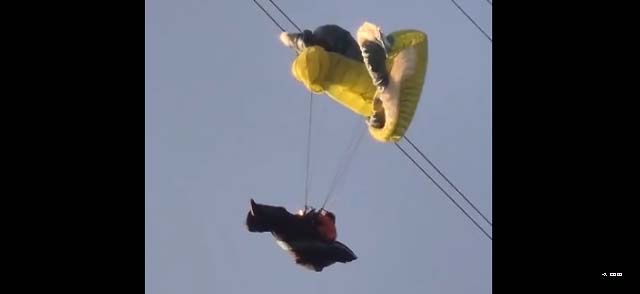
Russian paraglider pilot entangled
MANDI (Himachal Pradesh): A Russian paraglider pilot entangled in high-tension
power lines in Himachal Pradesh's Mandi district during his adventure ride on
Tuesday.
The pilot, Alexey (48), a Russian national, was safely brought down near Mehar
village, Tandu, about 5 km from Mandi town along the Pathankot-Mandi National
Highway (Mandi-Padhar highway). He had taken off earlier from the Bir Billing
paragliding site in neighbouring Kangra district. Bir-Billing is an internationally
renowned paragliding destination.
The incident happened when he lost control mid-flight and got trapped in high-tension
electricity wires hanging roughly 100 to 150 metres (approx. 200 feet) above
the ground.
He used his mobile phone to share his predicament with the Bir Billing Paragliding
Association, which in turn passed on the task to the Mandi district administration.
As part of rescue operation, the power depatment cut off supply to the 33-KV
line to prevent electrocutionof the adventurer. Ground teams spread safety nets
and mattresses. The National Disaster Response Force (NDRF), State Disaster
Response Force (SDRF), National Highways Authority of India (NHAI), local fire
services, police and Gawar Construction Company used machinery and a crane to
reach and safely bring him down. Following the rescue, Alexey was shifted to
the Zonal Hospital in Mandi for medical care.
Recent paragliding incidents in Himachal
With these the district's paragliding incidents in a month have reached five.
On October 25, a 47-year-old Bulgarian paraglider died near Rising Star Peak
in the Khanyara-Yol area, near Dharamshala in Himachal, while his 63-year-old
British flying partner was rescued.
October 21 and 24, in two incidents, tourists who took off from Bir were stranded
in remote hills before rescue teams brought them to safety.
Over 30 paragliders have crashed across Kangra and Mandi districts over the
past five years after launching from Billing, resulting in at least 10 pilot
fatalities.










 )