BOSTON, Jun 9 (INS): In a major blow to the administration’s immigration agenda,
a Federal judge on Monday struck down the controversial $100,000 fee imposed
on new H-1B visas for highly skilled foreign workers.
US District Judge Leo Sorokin ruled that the dramatic price hike constituted
an unauthorized tax that the executive branch had no constitutional power to
impose without the approval of Congress.
The decision brings immediate relief to tech giants, universities and healthcare
providers who argued that the exorbitant fee would paralyze America's ability
to recruit top-tier global talent.
The $100,000 (approx. Rs 95 lakh) fee was established via a presidential proclamation
on September 19 last year. Prior to this directive, employers sponsoring an
H-1B worker typically faced filing costs ranging from $2,000 to $5,000 only.
The administration heavily defended the unprecedented spike, framing it as
a necessary economic safeguard. Officials argued that the massive fee served
as a financial "monetary penalty" intended to deter corporations from replacing
domestic workers with cheaper foreign labour.
White House officials reiterated that the President possessed the broad legal
authority under Sections 212(f) and 215(a) of the Immigration and Nationality
Act (INA) to restrict the entry of foreign nationals if deemed in the national
interest.
However, the policy severely choked the specialized workforce pipeline. Data
revealed in court filings showed that US Citizenship and Immigration Services
(USCIS) had received only 85 payments of the $100,000 fee through mid-February.
Smaller businesses and public institutions, such as hospitals and universities,
noted they were completely priced out of the market.
The ruling came in response to a lawsuit spearheaded by a coalition of 20 Democratic
State attorneys-general, alongside parallel legal challenges from the US Chamber
of Commerce and higher education groups.
Judge Sorokin rejected the Government’s characterization of the $100,000 mandate
as a standard regulatory mechanism or penalty. In his decision, Sorokin wrote,
“The substance and application of the $100,000 payment reveal that it is a tax,
regardless of what the payment is called.”
The core legal logic behind the verdict hinges on the constitutional separation
of powers and the Administrative Procedure Act (APA):
Under the US Constitution, the power to levy taxes resides strictly with Congress.
Judge Sorokin concluded that the executive branch had vastly exceeded its authority,
noting that the policy "imposes a tax on H-1B petitions without the requisite
delegation by Congress."
While the administration attempted to leverage broad immigration enforcement
powers akin to border tariffs, the court ruled that an arbitrary internal fee
targeting specific employer petitions functioned strictly as a revenue-generating
tax, rendering it invalid without legislative backing.
What Happens Next?
The ruling applies nationwide, reverting H-1B application costs back to their
previous, pre-proclamation structures. Legal experts suggest a brief window
has now opened for cap-exempt employers, healthcare providers and tech firms
to aggressively file pending petitions without the financial burden.
The battle, however, is far from over. The White House expressed confidence
that Monday’s order would be reversed on appeal, setting the stage for a higher-court
battle that could ultimately head to the Supreme Court.
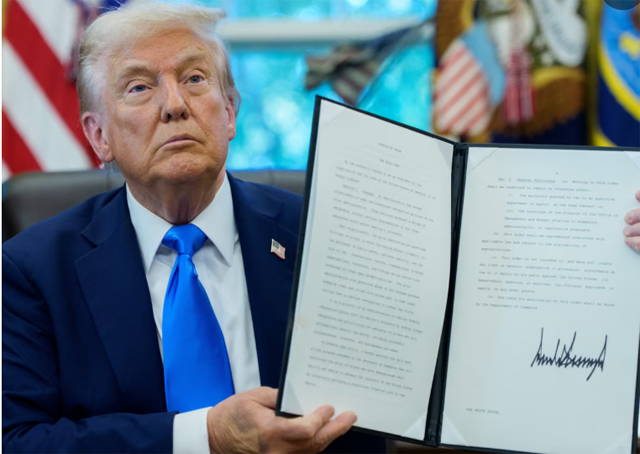
Donald Trump had signed the proclamation on September 19 last year that would
impose an annual $100,000 fee on H-1B visa applications, dealing a potentially
major blow to the US tech industry, which relies heavily on workers from India
and China.
The judge cited the Supreme Court's February verdict against Trump's tariffs
under a law meant for use in national emergencies. Sorokin found the case was
logically similar. A tax cannot be levied under the immigration law.
However, White House spokeswoman Taylor Rogers in a statement said the Trump
administration will appeal. "President Trump has clear legal authority to restrict
entry of any class of aliens he determines is not in America’s best interests,
and ?that is ?exactly what he did," she said.
The H-1B program allows 65,000 visas a year. Another 20,000 visas are given
for workers with advanced degrees, for three to six years. A visa for a foreign
worker before Trump's proclamation typically cost about $2,000 to $5,000 in
fees.
US employers and H-1B workers were shocked when the Trump administration issued
the proclamation on the new visa fee on September 19 last year.
The administration later clarified that the H-1B petitions filed before the
deadline of 12:01 am Eastern Time on September 21, 2025, will be considered
in the normal course. Previously issued and currently valid H-1B visas were
also not to be affected.
White House explains why the proclamation..."






 )
)