|
 |
|
|
Heavy
Snowfall in Kashmir SRINAGAR: The Kashmir valley experienced heavy snowfall leading to the closure of 300-km-long Srinagar-Jammu National highway. However, it was also celebration for the people. The higher mountains experienced continued snowfall while heavy rains lashed the plains. About 20 inches of fresh snow had accumulated on the highway between Qazigund to Banihal and about 25 inches of snow was recorded at Jawahar Tunnel, the highest point on the highway. But people were seen happy with the snowfall. Javeed, a local resident, said, "We are very thankful to god who made this snowfall happen. We prayed for this in mosque and god has heard our prayer. For the past one month we were suffering from water shortage and with the snowfall, I think that the situation would change. It will benefit the people. The snow-fall has also to an extent solved the problmes faced by the farmers in the area. The agriculture was badly hit due to a spell of dryness that the valley was experiencing for the past several months. There was virtual drinking water scarcity in the valley and this snowfall has come as a big respite for the people. The world famous ski resort of Gulmarg and Khilanmarg had recorded about six inches to one feet of fresh snowfall since Monday. The tourist spots of Pahalgam, Yusmarg, Deksum, Achabal, Aharabal and Nilnag also experienced fresh snowfall. The holy Amarnath cave, Sheshnag, Mahaguns, Panjtherni and Piso Top also experienced about one foot to two feet of snowfall. The border areas of Keran, Karnah, Teetwal and some remote areas of the frontier district of Kupwara were cut off from the rest of the State following heavy nowfall. Several localities, including Badshah Nagar, Natipora, Azad Basti, Bemina and Dilsoz Coloney, were under one foot of rain water because of faulty drainage system. Manali Buried Under Knee-deep
Snow MANALI: After a brief respite from the severe cold wave across India, people in Himachal Pradesh experienced biting cold with heavy snowfall hitting the region. Icy winds lashed the region throughout the day, intensifying the cold wave and forcing the local residents to remain indoors. The Solang ski slopes in Manali town were under knee-deep snow and recorded over 45 cm of snow while the key tourist resort of Manali had 15 cm of snow. Heavy snowfall led to road blockades at various areas. Traffic came to a virtual standstill at the Rohtang Pass. The entire Manali region remained engulfed in thick fog while tribal Lahaul valley was cut off due to heavy snowfall at Rohtang Pass. Most of the tribal areas, including the Lahaul valley, groaned under freezing cold with mercury staying between minus 12 and minus 18 degrees Celsius. But the chilling cold weather, however, could not dampen the spirits of tourists and revellers, who were seen in large numbers enjoying the weather. Children were having their share of fun, throwing snowballs on each other. Many people were seen lighting bonfires and danced throughout to keep themselves warm. Apart from Manali that received its first snowfall of the year, sharp showers lashed other parts of the State with temperature dipping below zero degree Celsius. Much of north India this year was hit by severe cold wave with temperatures falling below seven degrees Celsius. In Uttar Pradesh alone, more than 550 people died due to the severe cold wave. Weather officials said in earlier reports that the cold spell was the worst since 1962. Sky
Is Moving Up Due to Global Warming(Go
To Top) LONDON: Global warming has added to the woes of the atmosphere. This time it is being blamed for the upward movement of an important atmospheric layer, the 'tropopause.' Its rise - by an average of about 650 feet globally over the last 22 years - is new evidence for the reality of global warming, scientists say. Ben Santer of Lawrence Livermore National Laboratory said the atmosphere is layered, like a building with multiple floors. The lowest major layer is the troposphere, within which humans dwell. It varies from 5 to 10 miles deep and is deepest at the equator. Just above the troposphere is the stratosphere, the comparatively calm region through which commercial jets fly. The barrier between the troposphere and the stratosphere is the tropopause. In recent years, observers using weather balloons and other instruments began to suspect that the tropopause was slowly rising. Greenhouse gases, including carbon dioxide from the burning of fossil fuels, trap infra-red radiation, warm the atmosphere. Santer and his associates believe that as the warming accelerates, the troposphere expands. Tropospheric expansion nudges the tropopause upward. Another reason for the tropopause rise, Santer said in the report, is the disintegration of stratospheric ozone gas by commercially generated pollutants called chlorofluorocarbons (CFCs) No End
Yet to Dense Fog in Delhi (Go
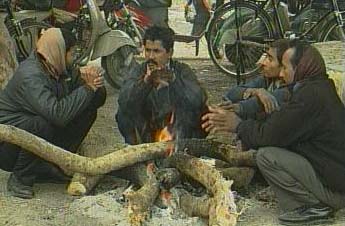
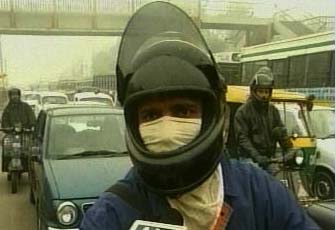
To Top) NEW DELHI: A thick blanket of fog engulfed New Delhi early on Saturday. Life came to a virtual standstill with traffic on the main roads moving at a snail's pace due to poor visibility. The vehicles moved slowly with their tail lights and fog lights switched on to avoid accidents. Several car owners, like Kewal Sharma, preferred to travel by city buses than risking taking out their own vehicles. "There is a lot of difficulty in travelling because of the fog. It is a big problem to take out one's own car. Like today I didn't take out my car at all, keeping this thing in mind that there could again be fog in the evening. It is better to travel by buses. We are facing a lot of problems because of the fog," Sharma said. But daily commuters said buses too were running behind schedule. "Because of the fog the buses are taking so long to come and we have been waiting for a bus for quite some time. And we are still waiting and hoping that it comes soon," said Pearl, a daily commuter. The dense fog also disrupted train schedules and forced closure of the runway at the Capital's airport. Delhi witnesses early morning fog every winter. Flights too often get delayed due to the fog. The recent installation of advanced anti-fog equipment at the Delhi airport has improved its functioning but it needs at least 15 metres height visibility and a visual range of 200 metres for flights to take off. Ttwo more people died in Kandhamal district of Orissa where temperatures dipped to below four degrees Celsius.Temperatures in Bhubaneshwar hovered around nine degrees Celsius, the lowest in two years. The worst-hit are the pavement dwellers, who kept themselves warm by lighting bonfires. A coastal State, Orrisa rarely experiences extreme climatic conditions. Punjab, in the north, also known as the country's granary, has been reeling under severe cold spell. Farmers in Ludhiana said most of the wheat, pulses and vegetable crops were badly affected by the severe cold. "I had grown cabbage and bottlegourds, but now nothing is left. I had invested Rs 10,000 in seeds and then another Rs 10,000 in cultivation, now I will suffer a loss of Rs 20,000," said Gurpal Singh, a farmer. More than 500 people have died due to cold this season in north India as minimum temperatures hovered between one and four degrees Celsius. Weather officials saw no let-up for at least a couple of days in the near-freezing temperatures gripping the region that they said were partly due to winds blowing in from Siberia. The entire South Asian region, including Bangladesh and Pakistan, is reeling under the cold spell. Although temperatures in South Asia do not fall as low in North America and Europe, people have been hit harder because millions in the region live on pavements or in makeshift shacks. Lack of good food worsens the cold's impact, lowering body heat and leading to hypothermia. Delhi
Still Wrapped in a Shroud of Fog (Go
To Top) NEW DELHI: The nation's Capital was buried under a thick blanket of fog early on Thursday, putting life at a standstill. Traffic on the main roads moved at a snail's pace due to poor visibility. The tail lights and fog lights of the vehicles were switched on to avoid accidents. The fog also disrupted train schedules and forced closure of the runway at the airport. Delhi witnesses early morning fog every winter, and flights too often get delayed because of it. The recent installation of advanced anti-fog equipment at the Delhi airport has improved its functioning but it needs at least 15-metre-height visibility and a visual range of 200 metres for flights to take off. More than 500 people have died due to cold this season in north India as minimum temperatures hovered from one to four degrees Celsius. Weather officials see no let-up for at least a couple of days in the near-freezing temperatures gripping the region that they said are partly due to winds blowing in from Siberia. While the mercury levels are mild by some standards, they can prove deadly in India where thousands are homeless or live in shacks without heat. Lack of good food worsens the cold's impact, lowering body heat and leading to hypothermia. Cold
Wave Claims Over 350 Lives in Northern India (Go
To Top) LUCKNOW: Icy winds swept across large parts of northern India on Tuesday as the total number of deaths from a month-long cold spell rose to over 350. Most of those dead were the poor and homeless living on pavements, often with just scraps of clothes to protect them from near-freezing temperatures resulting from fresh snowfall in the Himalayas.
The largest number of deaths were reported from Uttar Pradesh, the most populous State, where about 200 people had died in the past month in the country's worst winter in six years. RK Sharma, Director, Meteorological Department, said temperatures in parts of the State dipped to freezing (32 degrees Fahrenheit) point, forcing people to light bonfires by the roadside to keep themselves warm. "This year the temperatures have dipped very much like Lucknow recorded temperature of 2 degrees which is the lowest in last 20 years. As far as Kanpur is concerened, there is bound to be less temperature than the usual as it is open. So there will be 2 degree difference in the temperature always. And as far as the whole State (Uttar Pradesh) is concerned, it is in the grip of intense cold wave which will continue for a few more days," said Sharma. In Rajasthan, life has virtually come to a standstill due to intense cold wave sweeping the entire northern belt. In Jaipur, temperature has been hovering around 2.9 degrees Celsius in the recent weeks, the lowest in two years. Mercury dropped to one degree Celsius in Pilani, two degrees in Bikaner and three degrees in Ganganagar on Monday. People living on pavements have been keeping themselves warm by lighting bonfires. Authorities have distributed quilts and have built temporary overnight shelters for the poor. But still many were found sleeping on roadside with bare minimum facilities to protect themselves from the biting cold. So far, six people have died due to cold wave in the State. Although not cold by the standards of many other countries in the northern hemisphere, the drop in temperature often leads to a devastating effect on thousands of homeless. The authorities have distributed blankets and built temporary night shelters for the poor in schools and other buildings. Exposure kills dozens of people every year as temperatures drop at night. A dense fog shrouded large parts of India, throwing air, rail and road transport out of gear, and forcing the authorities to close schools in parts of northern India. Met officials said the chilly weather was likely to continue for the next few days. Polar Bears May Be Extinct
If Global Warming Continues: Expert (Go
To Top) WASHINGTON: An expert in Artic eco system has warned that unless the pace of global warming is abated, polar bears could disappear within 100 years. While it has been known for some time that the polar bear is in trouble, new research shows that Arctic ice - the polar bear's primary habitat - is melting much faster than scientists had believed, according to a University of Alberta biologist Dr Andrew Derocher. "The climate predictions coming out are showing massive changes in sea-ice distribution", said Derocher, who follows polar bears to see how they adapt to changing conditions. If the predictions are correct, he noted, "we will certainly lose polar bears in a lot of areas where we currently have them. Ice conditions in the Beaufort Sea, for example, are already changing dramatically". The world's largest terrestrial carnivores, polar bears rely on sea ice to survive, using it to pass between forest dens and hunting grounds where they prey on seals. There are about 15,000 polar bears in northern Canada, accounting for about two-thirds of the world's total population. Cold Wave Toll Mounts to
180 (Go
To Top) PATNA: North and eastern India's spell of bitterly two-week cold wave has killed 180 people in the past two weeks. The toll in eastern Bihar has doubled in the past 24 hours. Temperature in the State had dropped to 6.5 degrees Celsius (44 Fahrenheit) in some parts including Patna, East Champaran, Muzaffarpur and Nevada districts. Worst hit are the poor pavement dwellers who have little resources to keep themselves safe from the vagaries of the weather. The Government has started handing over free blankets to the poor and lighting bonfires alongside roads. Schools have been closed for younger students until January 14. The Government has also instructed the authorities to allow the use of public buildings, like school buildings and community halls, for shelter by homeless people, including rickshaw-pullers and labourers. The nearby Ranchi, Capital of Jharkhand State, recorded a low of one degree Celsius (34 degrees Fahrenheit). In national Capital New Delhi, chilly winds swept across the city resulting in a continuous decline of day and night temperatures. According to the Meteorological department, Monday was recorded as the coldest day of the season with mercury dipping to five degrees Celsius (41 degrees Fahrenheit), two degrees below normal. Rain, heat and cold weather kill thousands of poor people, many of whom sleep on pavements and streets in urban India. In May last year, more than 1,000 died due to an intense heat wave in Andhra Pradesh as the country grappled with temperatures in the range of 45 to 48 degrees Celsius. No
Let-up in Cold Wave (Go
To Top) VARANASI: The cold wave continues unabated across north India with at least 63 reported dead in Uttar Pradesh alone during the last three days. Most of the victims are the poor, homeless and the aged. So far the maximum number of deaths due to cold wave have been reported from Sonbhadra district where nearly 14 people have died. In Varanasi at least six deaths have been reported. The large number of deaths caused paucity of space at the cremation grounds. But the district officials denied the charge saying that they are extending all possible help to people. Meanwhile, in New Delhi, a sudden dip in temperature and foggy conditions made life and mobility difficult for the fifth consecutive day since December 31. The met department said that the immense cold is due to Western disturbances. In May last year, more than 1,000 died due to an intense heat wave in Andhra Pradesh as the country grappled with temperatures in the range of 45 to 48 degrees Celsius. Delhi Fog Disrupts Rail, Flight Schedules
(Go
To Top) NEW DELHI: Dozens of flights and trains were either delayed or cancelled on Thursday as a thick fog engulfed the national Capital. All flight schedules at the domestic as well as international airports were hampered since last evening and runway for incoming and outgoing flights was shut down after midnight.
According to airport officials, no flights took off or landed between midnight and 11:00 a.m. Runway visibility early on Thursday fell to 100 metres before improving to 500 metres by mid-morning. With fog settling down on railway tracks, some 37 incoming trains to New Delhi were delayed and three were cancelled. "We are unable to see the signals in the fog due to poor visibility. Due to this we have to slow down pace of trains to avoid accidents and trains get late," said Mange Ram, a train driver. Passengers were stranded at the railway station for hours as several trains were either cancelled or arrived late. Nainital,
Mussoorie Greet 2003 in Snowy Style
(Go
To Top) NEW DELHI: It was a new year filled with fun, frolic and snow for people in the hill resorts of Nainital and Mussoorie, as the two towns received the season's first snow fall. Hundreds of people, tourists and residents alike, came out in the open as miles of forest landscape took on the colours of white and green, giving the entire region a festive look. Though the snow was welcomed by all, it was particularly enthralling for the tourists, most of whom were witnessing a snowfall for the first time. "I came here day before yesterday from Chandigarh and it is my good luck that I was able to see this snowfall," said Anupama Prakash, a tourist. "We have seen a lot of places, but never seen snowfall. It is for the first time that we are witnessing snowfall and I am feeling very good," added Rakesh Pratap, another tourist. -ANI |