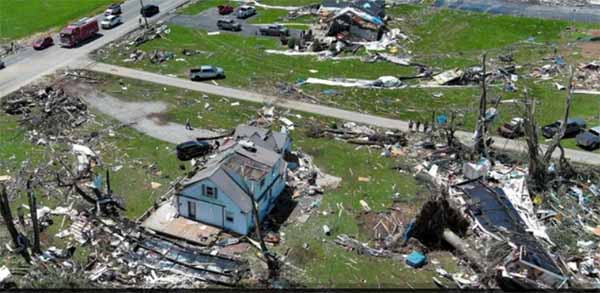
LONDON (Laurel County, Kentucky, US), May 17: Deadly tornadoes tore through
parts of US Midwest and South during weekend devastating property and claiming
at least 32 lives till Saturday.
Deaths counted 23 in Kentucky and seven people were killed in Missouri, including
five in St. Louis. Laurel County in the south-east of Kentucky was the worst
affected with 17 deaths. In Missouri 5,000 buildings have been damaged and power
lines downed, disconnecting 140,000 properties. A curfew was imposed in St Louis.
Two died in Virginia as trees fell on their vehicles.
Multiple tornadoes were reported starting from Wisconsin on Friday to Kentucky
and Illinois to the east coast next two days. Texas to New York were also at
risk for tornadoes and thunderstorms, according to AccuWeather.
The storms also caused critical injuries, displaced families, and left entire
neighborhoods unrecognizable.
The tornadoes tore through Forest Park, damaging landmarks such as the St.
Louis Zoo and the Centennial Christian Church, where a volunteer tragically
lost her life. The storms extended their reach into Wisconsin, Illinois, and
Virginia, causing widespread destruction and power outages.
Authorities are still assessing the full extent of the damage, but early reports
indicate that hundreds of homes have been destroyed or severely damaged. Emergency
responders worked through the night, searching for survivors amid the wreckage.
Kentucky Governor Andy Beshear urged the nation to support the affected communities,
emphasizing the need for urgent relief efforts.
One of those killed was Maj. Leslie Roger Leatherman, a firefighter who was
"fatally injured" while responding to the tornado.
Homeland Security Secretary Kristi Noem said in a statement Saturday evening
he spoke to Missouri Gov. Mike Kehoe, Kentucky Gov. Andy Beshear and Illinois
Gov. JB Pritzker "to offer federal resources and action for the deadly tornadoes
and storms impacting Missouri, Kentucky, and Illinois."
Noem said they "discussed how while emergency management is best led by local
authorities, we reinforced that DHS stands ready to take immediate action to
offer resources and support."
Emergency shelters have been set up in the hardest-hit areas, with donations
pouring in to support displaced families. First responders continue to search
for survivors, while meteorologists warn that more severe weather could be on
the horizon.
The National Weather Service has yet to confirm the exact number of tornadoes,
but preliminary reports suggest that the storms were among the most violent
and widespread in recent history.
As communities begin the long road to recovery, officials urge residents to
remain vigilant and prepare for potential future storms. The devastation serves
as a stark reminder of the unpredictable and deadly nature of extreme weather
events
April’s worst tornadoes
The devastation comes just weeks after April’s historic tornado outbreak, which
saw 150 confirmed tornadoes across 14 States. The outbreak, spanning April 2–7,
produced 40 strong tornadoes, including EF3-rated twisters in Missouri, Arkansas,
Kentucky, and Tennessee.
One of the most destructive tornadoes struck Lake City, Arkansas, leveling
homes and leaving residents in shock. In Kentucky, an EF3 tornado carved a path
through Louisville, marking one of the strongest tornadoes in the area since
1974. The storms also triggered catastrophic flash flooding, further compounding
the destruction. The slow-moving weather system caused over 318,000 power outages,
leaving communities struggling to recover.
At least 22 people died from flash flooding and tornado damage that swept across
multiple states in the the Midwestern and southern parts.
Nearly half of the reported deaths, which included children and elderly people,
were in Tennessee, and three were in Missouri. Three people died in Kentucky
while Indiana, Mississippi, Georgia and Arkansas have also reported deaths from
the storm.
Tornadoes usually occur in "Tornado Alley" during May and June.







 )
)